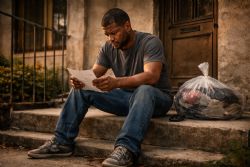

A Traumatic Policy
by R.C. Fox
You really don’t understand the full impact of a flawed departmental policy until it directly affects you and your family.
A while back I was talking to a journalist friend of mine about some of the incidents happening in the prison. We do this periodically, and during this conversation Beth happened to ask me about a certain inmate here. Apparently his mother contacted Beth because the last his family heard was that he'd been stabbed and they could get no further information. It didn’t surprise me that Beth asked this of me because over the course of our various conversations she will from time to time make similar requests. And this, after all, is part of what I do for her. I help obtain information. So as I go about getting this requested information I'm not really thinking that much about it. And as it turns out it wasn’t as severe a situation as feared, to the thankful family’s relief. And like I said, I really didn’t think much more about it because I do it all the time. That is until the events of December 4th 2022. On the evening in question I happened to walk outside in front of my dorm to speak to someone. It was around 8:30 p.m., drizzly rain in the air and no idea that my life was about to change drastically, not to mention put terror into my poor mother’s heart.
As I walked down the ramp then cut across a patch of cement in the direction of my destination I failed to see a spot on the concrete that may not be secure to walk on, however my left foot finds it with no problem. So with a slip, a crunch, and a hard impact on my left side I end up with my ankle broken in three places, all in a couple of seconds. I’m then quickly loaded into a wheelchair by my friends and rushed to the infirmary. Once evaluated I’m taken to the back gate, placed in a van, then carried away to the free world hospital. This all seems like the normal course of action following a traumatic event like this. But this is where the flawed policy raises his ugly head.
See, once inmates leave the confines of an Alabama institution all information on them goes into a black hole. And for certain security reasons I fully understand this. When we’re outside the camp we can’t call our families, they can’t come see us, nor can they know where we’ve been taken. One: to prevent escape. And two: for the safety of the officer as well as the inmate. But where the flaw comes in is that they also withhold the information on the incident itself. When I left the institution I was carried to the free world hospital where I remained for eleven days. During those eleven days I went through two surgeries on my ankle, all the while neither my family nor my friends had any clue of what was happening to me.
Now, I’m one who calls home regularly at a designated time. And once I started missing those calls my family became concerned. And so in their concern they started calling the institution. This was the only information provided. “Your son is in the hospital, but he’s still alive’.
Alabama’s prison system is considered one of the worst, if not the worst, in the nation. Declared unconstitutional by the Department of Justice. And Donaldson, where I am currently housed, is one of the deadliest in the country. So when a mother hears the words, ‘He’s in the hospital, but alive’, it opens the imagination to every horrific scenario that a parent or spouse can think of. I broke my ankle in a freak accident. People do this all the time. Hell, my mom's sister has literally done it twice in the last two years. But for eleven days my 75 year old mother could only assume at what traumatic torture I may have gone through to be ‘ In the hospital, but alive’ just because of a simple flaw in a policy that no one cares to correct. So hearing my mother's shaky breath as she finally gets a call from me when I returned and then hearing her say these words, ‘ I can finally go to sleep’, it literally brought tears to my eyes. Not to mention the long-lasting effects it’s had on my mother emotionally. Now if I call at an unscheduled time the first words from her or not ‘Hello', now it’s ‘What’s wrong’. But I also thought about all those other families that Beth’s asked me to check on, and she has people in other camps that help her in similar ways. But my heart went out to all of these families.
And it can all be fixed with a simple change in policy by Governor Ivey or Commissioner Hamm. Security secrets don't have to be exposed. All they need to do is appoint a comfort officer or liaison who could explain the situation.’ Hey,your son's at the hospital, we can't tell you where for security reasons, but he slipped and fell, he broke his ankle. He's fine though and we’ll have him call you as soon as he returns'. That took me less than a minute to write, less than that to say. And it didn’t compromise security anymore than ‘He’s in the hospital, but alive’. Now if the comfort officer feels too humane, say the information officer. Either way, there is no need to make families suffer because of an inhumane policy just because they love their incarcerated family members and are concerned about their safety and well-being.
Note: Beth Shelburne is from the Birmingham area and is a freelance journalist, prison reform activist, humanitarian, family woman, animal lover, and all around good person. Not to mention my friend and mentor.
 Visitor Comments (0)